
Finite Element Analysis of Deep Drawing of Rectangular Drawing Parts

In sheet metal forming processing, deep drawing is one of the main processing methods. The parts produced by it are widely used in electronics, automobiles, aerospace and other fields. It has the characteristics of light weight, good interchangeability and low cost. Because the traditional forming design scheme mainly depends on the experience of the designer, it is often necessary to adjust and modify the process parameters repeatedly, which is time-consuming and labor-intensive.The finite element method has also been widely used in sheet metal deep drawing as a computer and numerical simulation technology. However, it is still difficult to accurately simulate the influence of material, geometry and boundary nonlinearity in sheet metal deep drawing. relatively large. Therefore, it is of theoretical and practical significance to study the influence of process parameters on the forming process and to find the optimal process plan.
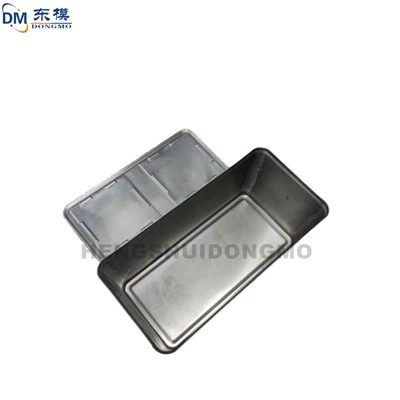
According to the above researched workpiece-rectangular drawing part and the characteristics of its actual machining process, a finite element calculation model for forming analysis of rectangular parts is established, and the computer simulation of the machining and forming process of this part is realized by using a general dynamic explicit calculation algorithm. , which effectively solves the discontinuous quasi-static problem in the machining process; the effects of the virtual speed of the punch, blank holder force, friction state, the shape of the die, especially the radius of the corners of the convex and concave die on the shape and accuracy of the rectangular part are studied. The influence of the box-shaped parts was discussed, and the problems of cracking and wrinkling in the deep drawing of box-shaped parts were discussed.
Through the simulation analysis, the following conclusions can be drawn:
1. The analysis results of forming limit diagram points show that the compressive stress of the four corners at the bottom of the corner of the rectangular box is the largest; the compressive stress of the center of the long and short sides is the smallest;
The results of the cloud map of thickness change show that: the thickness of the billet at the entrance of the die reaches 10%, which is the dangerous area of wrinkling.
2. Under certain process conditions, punching speed, blank holder force and friction coefficient have no effect on the simulation results of sheet metal forming wrinkling.
3. When the rectangular box is deep drawn, the punch radius and the die radius have a great influence on the wrinkling of sheet metal forming;
When the radius of the die fillet increases, the wrinkling tendency increases during deep drawing, and when the radius of the die fillet decreases, the rupture tendency of the rectangular sidewall increases;
When the radius of the punch fillet decreases, the four corners at the bottom of the rectangle are prone to crack. Under the experimental conditions of this paper, the radius of the punch and the radius of the concave die are both 6mm optimal.
4. Rectangular deep drawing during deep drawing, when the corner radius of the rectangle increases from 6 mm to 12 mm, the thinning rate of the rectangular sheet decreases continuously, and it is completely within the 20% safety margin;
At the same time, the thickening rate of sheet metal increases first and then decreases. When rc is 6mm, the thickening rate is within the safety margin of 8.6%.
The above is the analysis brought to you by Dongmo, I hope it will be helpful to you.