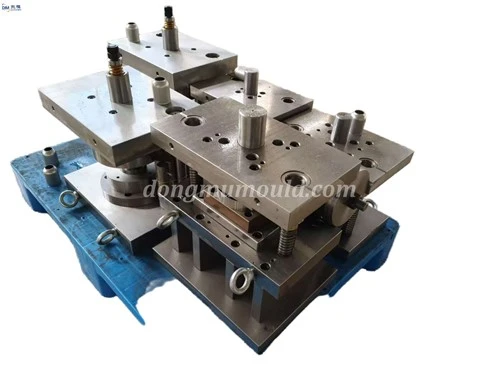

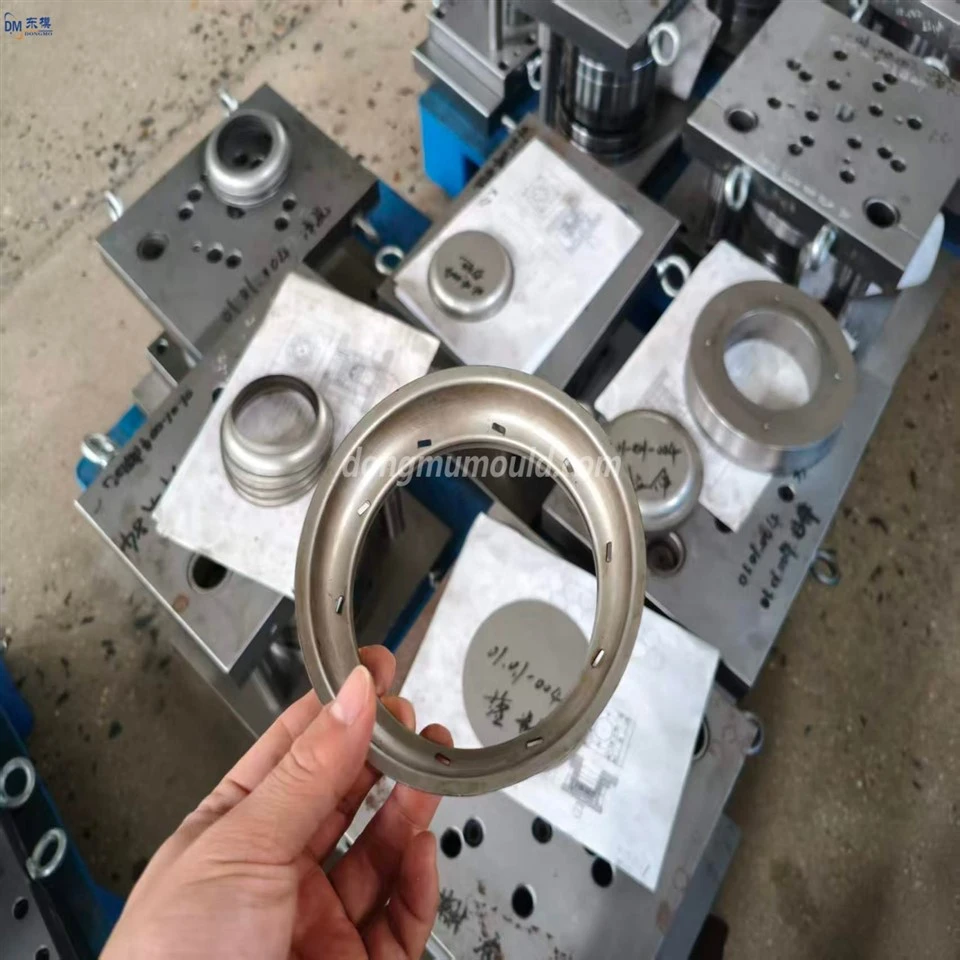


Motor laminations are stacked in thousands to build a single stator or rotor core. Each lamination must match the others almost exactly, or the stack will not align properly when assembled. A compound die solves this by cutting the entire lamination shape - outer profile and inner slots - in one downward stroke. There is no repositioning between cuts, so every lamination is dimensionally identical.
Silicon steel used in motor cores is brittle and tends to chip at the cut edges if the die clearance is wrong. We calculate clearance based on the actual silicon content of your material, not a generic value from a handbook. The die also uses a spring-loaded stripper plate that holds the sheet flat during cutting, which reduces edge cracking and extends the life of the cutting edges.


Compound dies run at slower stroke rates than progressive dies, typically 40-80 strokes per minute, but they make up for it with zero station-to-station alignment error. We harden the die block and punch to 58-60 HRC and finish the cutting edges by wire EDM to a surface roughness below Ra 0.4 micrometres. This combination delivers consistent burr heights below 0.05 mm over long production campaigns.
WhatsApp: +8615930861038
Wechat:+8615930861038/+8618832809957
Email: dongmumold@163.com
Hot Tags: compound stamping die for electrical motor lamination cores, China, suppliers, manufacturers, factory, buy, price, made in China, progressive die press, Progressive Die Stamping, progressive sheet metal dies, progressive stamping tool, Punching die, Round pipe punching die