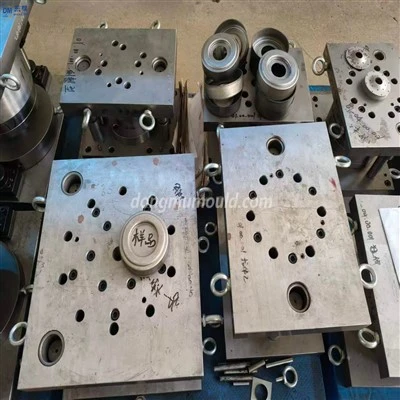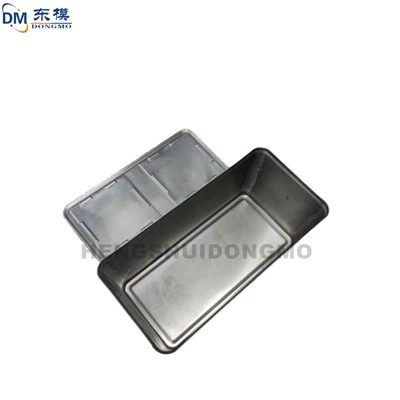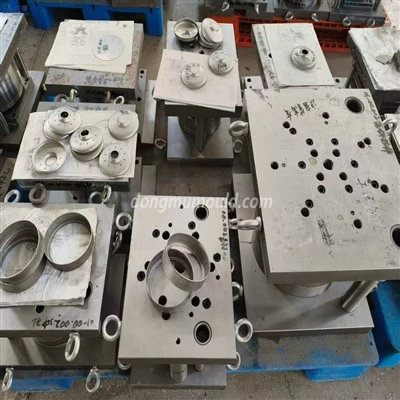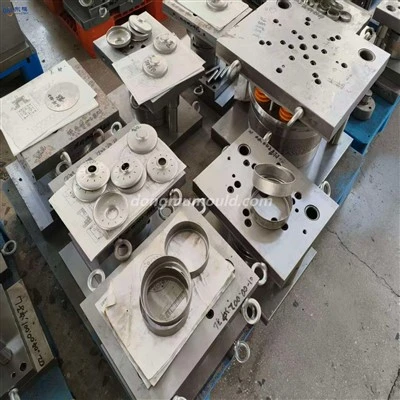

There are many forms of stamping dies, and stamping dies are also classified according to the nature of work, mold structure, and mold material.
Classified according to the nature of the process
A. Punching die A die that separates materials along a closed or open outline. Such as blanking die, punching die, cutting die, slitting die, trimming die, cutting die, etc.
B. Bending mold It is a mold that makes the sheet blank or other blanks bend and deform along a straight line (bending line) to obtain a certain angle and shape of the workpiece.
C. Deep-drawing die is a die for making a blank sheet into a hollow part with an opening, or to further change the shape and size of the hollow part.
D. Forming mold is a mold that directly replicates the blank or semi-finished workpiece according to the shape of the convex and concave molds, and the material itself only generates local plastic deformation. Such as bulging molds, necking molds, flaring molds, undulating forming molds, flanging molds, shaping molds, etc.
E. Riveting mold is to use external force to connect or overlap the participating parts in a certain order and manner to form a whole.
Classified according to the degree of process combination
A. Single-process mold In one stroke of the press, only one stamping process mold is completed.
B. Compound mold There is only one station. In one stroke of the press, two or more stamping processes can be completed on the same station at the same time.
c. Progressive die (also called continuous die) In the feeding direction of the blank, there are two or more stations. In one stroke of the press, two or two passes are completed in different stations one by one. Die for the above stamping process.
d. The transfer mold combines the characteristics of single process mold and progressive mold. The robot transfer system is used to realize the rapid transfer of the product in the mold, which can greatly improve the production efficiency of the product, reduce the production cost of the product, save the cost of the material, and have stable quality reliable.
Classified by product processing method
According to different product processing methods, molds can be divided into five categories: punching and shearing molds, bending molds, drawing molds, forming molds and compression molds.
A. Punching and shearing dies: the work is done by shearing. Commonly used forms are shearing dies, blanking dies, punching dies, trimming dies, trimming dies, punching dies and punching dies.
b. Bending mold: It is the shape of bending the flat blank into an angle. Depending on the shape, accuracy and production volume of the part, there are many different forms of mold, such as ordinary bending die, cam bending die, curling Stamping dies, arc bending dies, bending punching dies and twisting dies, etc.
C. Drawing mold: Drawing mold is to make flat blank into seamless container with bottom.
D. Forming die: refers to the use of various local deformation methods to change the shape of the blank. Its forms include convex forming die, curling edge forming die, necking forming die, hole flange forming die, and round edge forming die.
E. Compression mold: It uses strong pressure to make the golden wool embryo flow and deform into the desired shape. Its types include extrusion dies, embossing dies, embossing dies, and end pressure dies.