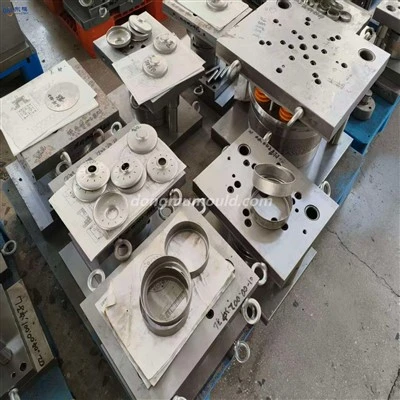

The principle of stamping die Stamping is a pressure processing method that uses a die installed on a press to apply pressure to the material at room temperature, causing it to separate or plastically deform, so as to obtain the required parts.
1. Working process of stamping die:
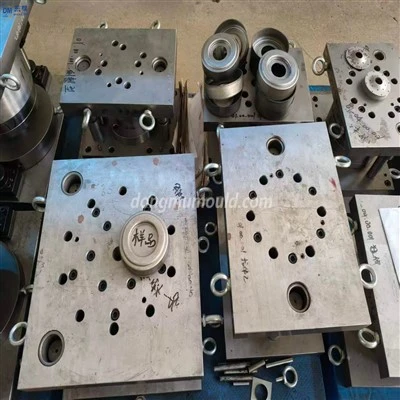
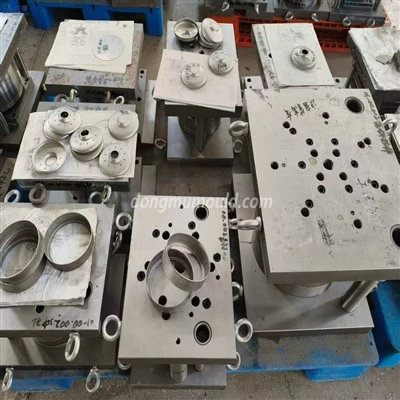
The working principle of the blanking die is as follows, directly or directly connected to the upper die of the mold which is fixed on the upper die, and it is connected to the punch slider through the die handle. The zeros fixed on the lower mold constitute the lower mold of the mold, and are fixed on the worktable of the punching press with a pressing plate. The upper mold and the lower mold are guided by guides and guides. When working, the strip is fed and positioned against the stopper. When the upper die descends with the slider, the unloading first presses the sheet, and then the material on the concave surface is punched out to obtain the workpiece. At this time, the work piece is stuck in the punch and the top block, and the waste material is also tightly clamped on the punch. When the upper mold rises, the workpiece is ejected from the cavity of the concave mold by the elastic force of the spring from the top block against the top plate; at the same time, the waste material hooped on the punch is removed by the unloading plate by the elastic force of the spring, and then the workpiece is taken away. Complete the entire blanking process. Then feed the strip into one step, and proceed to the next blanking process, and so on.
Second, the classification of stamping dies:
1. Open mold: simple structure, small size, light weight, easy manufacturing, low cost, but low life, poor accuracy,
It is suitable for blanking parts with low precision requirements, simple beginning, small batch or trial production.
2. Guide plate type: The accuracy is higher than that of the open die, and it is suitable for blanking parts with simple beginning and small workpiece size. The stroke of the press is required to be no greater than the thickness of the guide plate.
3. Guide pillar type: The guide pillar is oriented to ensure uniform blanking gap, high precision of the workpiece size of the punched parts, long service life of the mold, easy installation, and suitable for mass production.
4. Continuous mold: The strip requires precise positioning to ensure the mutual position accuracy of the inner hole and the shape. High productivity, with certain blanking accuracy, suitable for mass production.
5. Compound mold: The inner and outer shape of the stamping parts have high mutual position accuracy, which is suitable for mass production.