

What are the main characteristics of mold manufacturing
MFC sheet metal forming die, under the action of external forces to make the blank into a specific shape and size of the tool. Die is widely used in blanking, die forging, cold heading, extrusion, powder metallurgy parts pressing, pressure casting, as well as engineering plastics, rubber, ceramic and other products in the pressure plastic or injection molding process. Therefore, mold manufacturing belongs to the category of machinery manufacturing, its development level is one of the important symbols of the level of machinery manufacturing.
In recent years, our mold manufacturing level has been rising, and it is gradually developing into mechanization, precision and automation of high-tech intensive industry. Its main characteristics are as follows:
(1) Die manufacturing quality requirements are high: the development of manufacturing industry makes many product parts have very high requirements on the quality of the die, including the dimensional accuracy, shape accuracy, processing accuracy) of the die parts, surface roughness, and the service life of the die is required to be long.
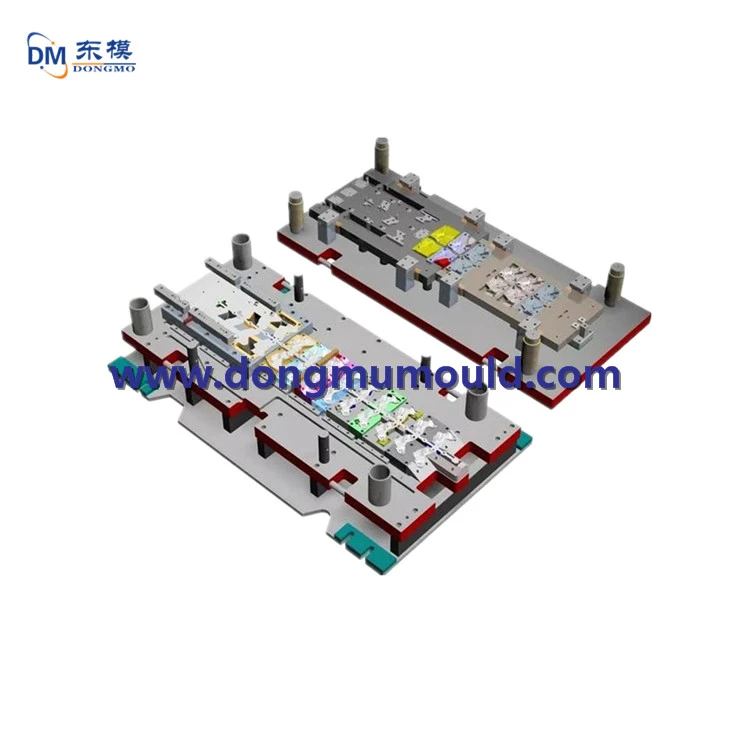
(2) High hardness of mold manufacturing materials: molds are tools used to make molded items. The hardness of materials is higher than that of accessories. Generally, they are quenched alloy steel or hard alloy and processed by non-traditional methods.
(3) High difficulty in mold manufacturing and processing: the module, as the carrier of the mold cavity, is generally composed of moving, fixed mold and core, mainly two-dimensional or three-dimensional complex surface. General cutting is only suitable for processing simple geometric shapes, so the processing difficulty of mold manufacturing is very high, and the accuracy is not easy to ensure.
(4) Short production cycle of mold manufacturing: because of product upgrading and fierce market competition, mold manufacturing must shorten the production cycle. Using rapid prototyping technology to produce mold can shorten two-thirds of the time cycle than the traditional method.

(5) Single piece and complete set production: Because of the replicability of mold products, mold manufacturing is generally single piece production, that is, can only produce a specific shape, size and precision of the parts. When producing a part, it is necessary to use more than one pair of molds to complete the processing. Each submold is implicated with each other, and the connection between each set of molds should be considered.


